| ||
 |
||
 | ||
|
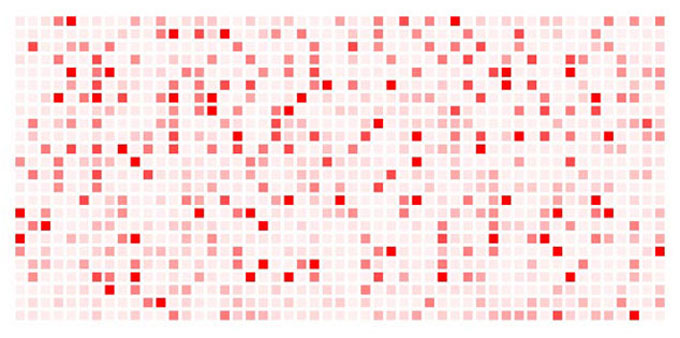
"The Dead" is the product of a program that produces a concordance of a text and then generates a visual representation of the text based on the frequency with which each word appears in the original text. Each of the thousands of little squares in the image represents a word in the source text. The saturation of the color of each square represents the frequency with which the corresponding word appears in the text. Dark red squares are words like "the" and "a", while light pink squares are words like "Lily" and "caretaker's". As in my 2005 project, "The Waste Land," a literary masterwork is both reduced and expanded, redefined as it moves from a purely symbolic space to a purely visual one. As with "The Waste Land," the program that produced "The Dead" is extremely flexible. The core elements of the program are the creation of the concordance and the consequent translation of the text. How this translation is represented can vary significantly: variation in color can be replaced with variation in size or position; the current vertical mass can be replaced with a single horizontal or vertical line, or a (nearly) perfect square. The present orientation is determined by the paper and printer used to produce the final physical work. The program used to generate "The Dead" was written in Processing. Images are exported using the PDF Export Library and printed manually on a large format printer. Click on the image above to view a the complete piece. | ||
 | ||
|
This piece is based in large part on work I have done as a painter, as well as my 2005 project "The Waste Land," a large-scale visual representation of the T.S. Eliot poem encoded in binary. In the past, the entire process of generating one of these code pieces, from selection of text through encoding and rendering with ink on paper or paint on canvas, was carried out by hand. Typically, a piece consisting of ten lines of verse took as long as 40 hours to generate. The program used to generate "The Dead" is my second attempt to pass some of the work along to a computer, and my first attempt to use language processing techniques that cannot be performed without the aid of a computer. The program was written in conjunction with the course "Programming from A to Z," taught by Dan Shiffman in the Interactive Telecommunications Program, Tisch School of the Arts, New York University. | ||
 | ||
|
This project makes use of the story "The Dead," by James Joyce. The programming could not have been completed without the invaluable assistance and instruction of Dan Shiffman and my classmates in the Interactive Telecommunications Program at NYU. In addition, I am deeply indebted to the writings of Rosalind Krauss and the work of Agnes Martin, Bridget Riley, Chuck Close, Sol LeWitt, John Cage and Jackson Mac Low. | ||
This project was created for educational purposes and its use of coyprighted material is protected by the doctrine of fair use. |